
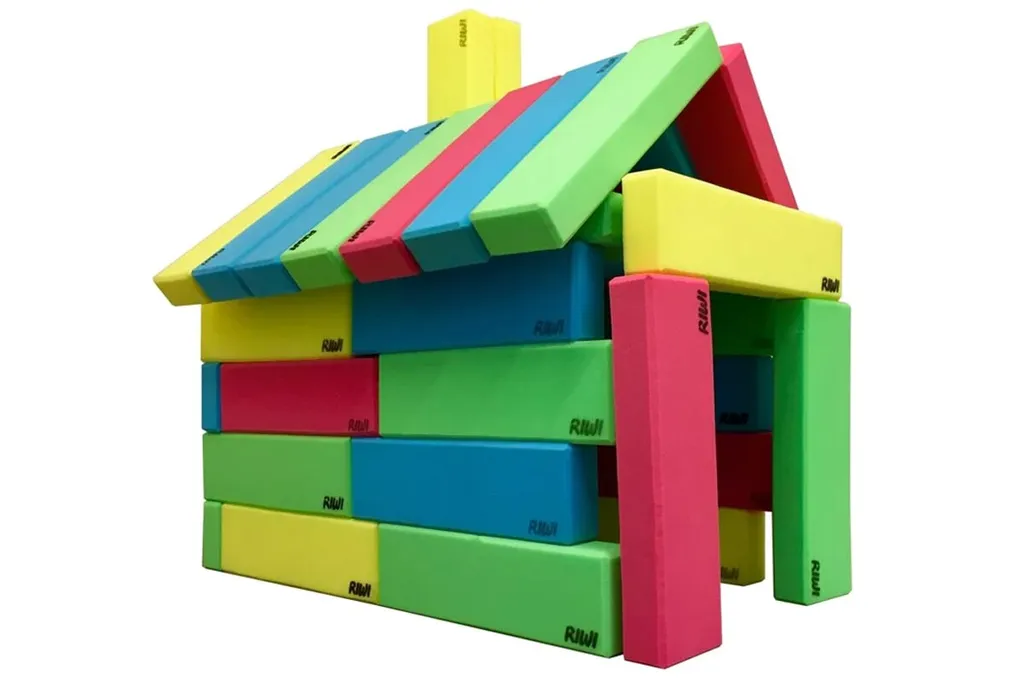
Giant Building Blocks are an exciting way for children to discover construction, creativity, and exploration through hands-on play. Giant Building Blocks give young builders the freedom to stack, connect, arrange, and redesign large pieces while developing their imagination. For parents, teachers, daycare providers, and play centers, Giant Building Blocks create opportunities for children to explore how structures work while enjoying an engaging screen-free activity. Whether building a tall tower, a miniature town, or an imaginative adventure space, children can turn simple pieces into endless possibilities.
Why Giant Building Blocks Encourage Exploration
Children are naturally curious about how objects fit together and what they can create with them. Large construction pieces provide a physical way to investigate these questions. Instead of simply observing a finished toy, children become the designers and builders.
Giant Building Blocks allow children to experiment with height, balance, shape, spacing, and structure. They can construct something, observe the result, make changes, and try again. This process makes play both entertaining and educational.
Open-Ended Construction Play
Open-ended toys do not have one specific way to be used. A collection of blocks can become a house during one play session and a bridge, castle, robot, or vehicle during another.
This freedom encourages children to make decisions independently. They can choose their own materials, designs, colors, and construction methods. There is no requirement to copy a particular model, allowing creativity to develop naturally.
Learning Through Trial and Error
A structure that collapses can become an important learning opportunity. Children begin to understand that some designs require stronger foundations or better weight distribution.
Giant Building Blocks make experimentation accessible because children can quickly take apart their creations and start again. Repeated attempts help develop patience, persistence, and problem-solving abilities. For more information about large building blocks for kids, explore their features, benefits, age suitability, and role in encouraging imaginative and educational play.
Building Skills Through Hands-On Play
Construction activities involve much more than placing one block on another. Children are constantly making observations and decisions as they build.
Developing Spatial Awareness
When children arrange blocks, they learn about physical relationships such as above, below, beside, inside, outside, near, and far. They also become more familiar with concepts such as height, width, depth, and symmetry.
Giant Building Blocks provide a large-scale way to practice these concepts. Because the pieces are easy to see and handle, children can physically explore how different shapes interact.
Improving Coordination
Picking up, carrying, positioning, and stacking blocks encourages hand-eye coordination. Children must control their movements to place pieces accurately.
Large blocks can also encourage gross motor activity when children move pieces around a play area. This combination of movement and construction makes block play a versatile indoor activity.
Encouraging Planning
As children gain experience, they may begin planning their structures before construction starts. They might decide where the foundation should go, which blocks should form the walls, and how the finished structure should look.
This simple planning process supports organized thinking and introduces children to basic design principles.
Exploring Different Types of Structures
One of the most enjoyable aspects of construction play is discovering how many different things can be created from the same collection of pieces.
Towers and Skyscrapers
Building a tall tower is a classic challenge. Children can experiment with wide foundations, different block arrangements, and various heights.
They may discover that a stable structure needs a strong base. This introduces an early understanding of balance and structural stability without requiring formal lessons.
Bridges and Tunnels
Bridges provide another interesting construction challenge. Children can create two supporting sections and place blocks between them.
Tunnels encourage children to think about enclosed spaces. They can build pathways underneath or through their structures and incorporate imaginative characters into their designs.
Houses and Miniature Communities
Children can use large construction pieces to create homes, shops, schools, parks, and other buildings. Once several structures are complete, they can connect them into an imaginary neighborhood.
Giant Building Blocks can therefore become the foundation for both construction and pretend play. Children can invent characters, create stories, and explore how their imaginary community operates.
Educational Value of Giant Building Blocks
Building and exploring with blocks can support several areas of childhood development.
Early STEM Learning
Construction naturally introduces concepts related to science, technology, engineering, and mathematics. Children explore balance, gravity, measurement, shapes, patterns, and cause and effect through practical experiences.
Giant Building Blocks make these concepts tangible. Rather than learning only from pictures or explanations, children can manipulate objects and immediately observe the results.
Mathematics and Patterns
Blocks can be sorted according to size, shape, or color. Children can create repeating patterns or count the number of pieces used in a structure.
Teachers can turn these activities into simple mathematics exercises by asking questions such as how many pieces are needed to make a tower taller or which structure contains more blocks.
Language and Storytelling
Construction can also support communication. Children often explain what they are building, describe their plans, or create stories about their finished structures.
Parents and educators can encourage this development by asking children to explain their designs. Questions such as “What is this building?” or “Who lives there?” can encourage children to use descriptive language.
Giant Building Blocks for Group Activities
Construction does not have to be an individual activity. Children can work together to create larger projects.
Cooperation and Teamwork
Group building teaches children how to share materials and communicate ideas. One child might build a foundation while another creates walls or decorative elements.
Giant Building Blocks can encourage cooperative problem-solving because children must discuss their plans and find ways to combine different ideas.
Classroom Building Challenges
Teachers can create simple challenges such as building the tallest tower, making a bridge between two points, or constructing a structure that can hold another block.
These challenges provide clear goals while still leaving children free to decide how they will reach them.
Creating an Ideal Building Environment
A suitable environment can make construction play more comfortable and productive.
Provide Enough Space
Children need enough room to spread out their blocks and move around their structures. A dedicated play area can prevent accidental bumps and make cleanup easier.
A carpet or play mat can provide a comfortable surface for floor-based construction while reducing the impact noise caused by moving pieces.
Organize Blocks by Type
Sorting pieces into containers can make construction easier. Children can quickly find the shapes or sizes they need and learn basic organizational habits.
Storage also makes cleanup part of the activity. Children can practice putting their construction materials away after finishing their projects.
Making Every Building Session Different
The versatility of Giant Building Blocks means children can enjoy a new challenge each time they play. Parents can introduce themes such as space stations, farms, transportation centers, animal habitats, or futuristic cities.
Children can also be encouraged to rebuild an existing structure in a completely different way. This promotes flexible thinking and demonstrates that there can be multiple solutions to the same construction challenge.
The most important goal is not creating a perfect structure. The value comes from the process of experimenting, exploring, imagining, and learning.
Frequently Asked Questions
1. What are Giant Building Blocks used for?
Giant Building Blocks can be used for stacking, construction, imaginative play, storytelling, educational activities, and cooperative building projects. Children can create structures ranging from simple towers to elaborate imaginary environments.
2. What skills do children develop through block building?
Children can develop spatial awareness, hand-eye coordination, planning, creativity, problem-solving, communication, persistence, and early mathematical thinking through construction play.
3. Can Giant Building Blocks be used in classrooms?
Yes. Teachers can incorporate them into STEM activities, mathematics lessons, creative-play stations, storytelling exercises, and group construction challenges.
4. Are large building blocks suitable for group play?
Yes. Group construction can encourage teamwork and communication. Children can share materials, divide tasks, discuss designs, and solve construction problems together.
5. How can parents make block play more educational?
Parents can introduce simple challenges, ask children to count pieces, identify shapes, compare heights, create patterns, or explain how their structures work. These questions turn natural play into valuable learning experiences.
Conclusion
Giant Building Blocks provide children with an effective combination of building, discovery, imagination, and learning. From developing spatial awareness to encouraging early STEM concepts, construction play gives children practical opportunities to understand how objects interact. Large building pieces also support storytelling, teamwork, coordination, and independent creativity.
Whether used at home, in a classroom, or in a childcare environment, Giant Building Blocks can transform ordinary playtime into an exploration of design and possibility. Children can build towers, bridges, houses, communities, and imaginative worlds while learning through hands-on experimentation. With an open-ended collection of construction pieces, every session can become a new opportunity to build, explore, solve problems, and discover something different.